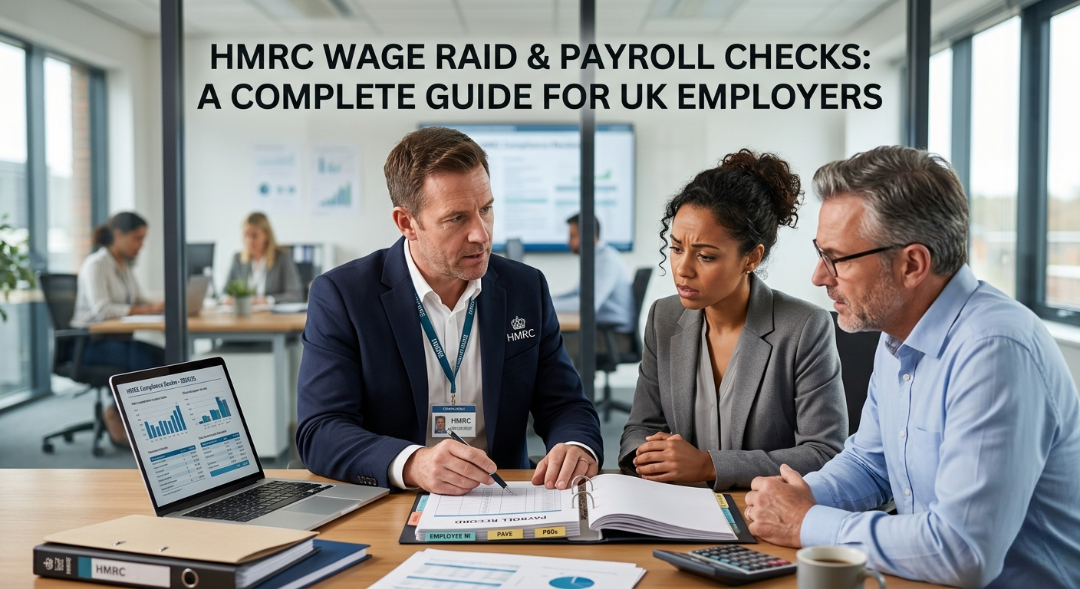
HMRC Wage Raid & Payroll Checks: A Complete Guide for UK Employers

Payroll compliance in the UK has become more closely monitored than ever, and many employers now worry about sudden investigations or so-called “HMRC wage raids.” While the phrase sounds dramatic, it typically refers to unannounced or formal compliance checks carried out by the UK tax authority, HM Revenue & Customs.

These payroll checks are not random acts of disruption. Instead, they are part of a structured enforcement strategy designed to ensure businesses are correctly reporting wages, paying the right taxes, and following employment law obligations.

In this guide, we break down exactly what HMRC wage raid payroll checks involve, why they happen, how they unfold, and most importantly how businesses can stay fully compliant and avoid penalties.

Whether you run a small business, manage HR, or handle payroll internally, understanding these processes can protect your company from financial and legal risk.

What Is an HMRC Wage Raid?

The term “wage raid” is not an official HMRC term. It is commonly used in media and business circles to describe:

  • Surprise inspections of payroll records
  • Targeted compliance audits
  • Investigations into suspected tax avoidance or payroll fraud
  • On-site visits by HMRC compliance officers

In reality, these are part of structured enforcement procedures conducted by HM Revenue & Customs to ensure employers are:

  • Paying employees correctly
  • Deducting the right Income Tax and National Insurance
  • Reporting payroll data through RTI (Real Time Information)
  • Following minimum wage laws
  • Avoiding off-payroll or “cash-in-hand” arrangements

A wage raid may be announced or unannounced depending on the severity of suspicion or risk indicators.

Why HMRC Carries Out Payroll Checks

HMRC does not randomly target businesses. Instead, payroll checks are usually triggered by risk signals or inconsistencies.

Common reasons include:

1. Payroll inconsistencies

  • Mismatched RTI submissions
  • Sudden wage fluctuations
  • Incorrect tax code usage

2. National Minimum Wage concerns

  • Employees being underpaid
  • Incorrect apprenticeship rates
  • Excessive unpaid working hours

3. Irregular cash payments

  • Large amounts of cash wages
  • Lack of proper payroll records

4. Employee complaints

  • Workers reporting underpayment
  • Disputes over payslips or deductions

5. Data matching anomalies
HMRC cross-checks:

  • Bank data
  • VAT returns
  • Company accounts
  • Pension submissions

6. Industry risk profiling
Certain sectors face higher scrutiny:

  • Hospitality
  • Construction
  • Care services
  • Retail
  • Gig economy businesses

What Happens During an HMRC Wage Raid?

When HMRC initiates a payroll investigation or visit, it usually follows a structured process.

1. Arrival of compliance officers

Officers may arrive unannounced at business premises. They will present identification and explain the purpose of the visit.

2. Request for records

HMRC may request access to:

  • Payroll software
  • Employee contracts
  • Payslips
  • RTI submissions
  • Timesheets and attendance records
  • Bank payment records

3. Employee interviews

In some cases, officers may speak directly to staff to confirm:

  • Hours worked
  • Payment accuracy
  • Working conditions

4. Data analysis

HMRC compares internal records with submitted tax data to identify discrepancies.

5. Follow-up investigation

If issues are found, HMRC may extend the investigation into a full compliance audit.

Types of HMRC Payroll Checks

Not all investigations are the same. HMRC uses different levels of scrutiny depending on risk.

1. Routine compliance check

A standard review of payroll records without serious suspicion.

2. Targeted investigation

Triggered by specific concerns such as underpayment or tax avoidance.

3. Full employer compliance review

A detailed audit covering multiple tax years.

4. Criminal investigation (rare)

Reserved for serious fraud or deliberate tax evasion cases.

What HMRC Looks for in Payroll Audits

During wage raids and payroll inspections, HMRC focuses on key compliance areas.

Payroll accuracy

  • Correct gross-to-net calculations
  • Proper tax deductions
  • Accurate overtime payments

Real Time Information (RTI) compliance

Employers must submit payroll data on or before payday.

National Minimum Wage compliance

Checks ensure employees are not underpaid, including:

  • Training time
  • Travel time (in some cases)
  • On-call hours

Employment status classification

HMRC assesses whether workers are correctly classified:

  • Employee
  • Worker
  • Self-employed contractor

Misclassification is a major risk area.

Benefits and expenses reporting

Company benefits must be properly reported and taxed.

Warning Signs That May Trigger HMRC Attention

Businesses often unknowingly attract HMRC scrutiny. Key red flags include:

  • Frequent payroll corrections
  • Late RTI submissions
  • Large amounts of manual payroll adjustments
  • High use of subcontractors
  • Significant cash wage payments
  • Discrepancies between accounts and payroll data

Even small inconsistencies can trigger a deeper review.

Penalties for Payroll Non-Compliance

If HMRC finds errors during a wage raid or payroll audit, penalties can be significant.

Financial penalties may include:

  • Backdated tax payments
  • Interest on unpaid tax
  • Fines for late reporting
  • Penalties for incorrect RTI submissions

Serious cases may involve:

  • Penalties up to 100% of unpaid tax
  • Public naming of non-compliant employers
  • Criminal prosecution (in severe fraud cases)

How Long Do HMRC Payroll Investigations Last?

The duration depends on complexity:

  • Minor checks: a few weeks
  • Standard audits: 3–6 months
  • Complex investigations: 1 year or more

Delays often occur when businesses fail to provide complete records quickly.

How to Prepare for HMRC Payroll Checks

Preparation is the most effective way to reduce risk.

1. Maintain accurate payroll records

Ensure all employee data is:

  • Up to date
  • Consistent
  • Properly archived

2. Use compliant payroll software

Modern systems reduce human error and improve RTI compliance.

3. Conduct internal audits

Regularly review:

  • Payroll calculations
  • Tax deductions
  • Employee classifications

4. Train payroll staff

Ensure staff understand:

  • HMRC rules
  • Minimum wage laws
  • Reporting deadlines

5. Keep documentation organized

HMRC may request:

  • Contracts
  • Timesheets
  • Payment records

How to Respond During an HMRC Wage Raid

If HMRC visits your premises:

Do:

  • Stay calm and cooperative
  • Provide requested documents promptly
  • Assign a responsible manager or payroll officer
  • Keep communication professional

Don’t:

  • Hide or alter records
  • Delay responses unnecessarily
  • Provide incomplete information

Cooperation can significantly reduce penalties.

Common Mistakes Employers Make

Many payroll issues arise from avoidable mistakes:

  • Incorrect employee classification
  • Poor record-keeping
  • Manual payroll errors
  • Ignoring minimum wage updates
  • Late RTI submissions
  • Misunderstanding overtime rules

Even honest mistakes can result in penalties if not corrected quickly.

Expert Insight: Why HMRC Focuses Heavily on Payroll

Payroll is one of the most sensitive areas of taxation because it directly affects employee income and government revenue.

From an enforcement perspective, payroll checks are effective because:

  • Data is digitally reported in real time
  • Employers are responsible for deductions
  • Errors are easy to detect through cross-matching
  • High compliance risk industries are identifiable

This makes payroll a priority area for HM Revenue & Customs enforcement strategy.

How to Avoid HMRC Payroll Problems Long-Term

Sustainable compliance requires ongoing effort:

  • Implement monthly payroll reconciliations
  • Stay updated with UK tax law changes
  • Use automated payroll systems
  • Schedule annual external audits
  • Maintain clear HR documentation

Consistency is key to avoiding unexpected investigations.

Conclusion

HMRC wage raid payroll checks are a serious but manageable aspect of running a business in the UK. While the term “raid” may sound alarming, these inspections are ultimately designed to ensure fairness, transparency, and correct tax reporting.

By understanding how HM Revenue & Customs operates, maintaining accurate payroll systems, and proactively addressing compliance risks, businesses can avoid penalties and operate with confidence.

The key takeaway is simple: good payroll hygiene is not optional it is essential for long-term business stability and legal protection.

FAQ: HMRC Wage Raid Payroll Checks

1. What is an HMRC wage raid?

It refers to an unannounced or targeted payroll inspection by HMRC to check tax and wage compliance.

2. Can HMRC come to my business without warning?

Yes. In many cases, compliance officers may arrive without prior notice.

3. How long do payroll checks take?

Anywhere from a few weeks to over a year, depending on complexity.

4. What triggers HMRC payroll investigations?

Common triggers include payroll errors, late RTI submissions, and minimum wage concerns.

5. What happens if HMRC finds mistakes?

You may need to pay backdated tax, interest, and penalties.

6. Can small businesses be targeted?

Yes. HMRC investigates businesses of all sizes, especially in high-risk sectors.

7. How can I prepare for HMRC checks?

Maintain accurate records, use payroll software, and conduct internal audits regularly.

HMRC Wage Raid Payroll Checks Explained: A Complete Guide for UK Employers

If you’ve recently searched for HMRC wage raid payroll checks, you’re probably trying to understand what these investigations involve and whether your business could be affected.

Although “wage raid” is not an official term used by HM Revenue & Customs (HMRC), many business owners use it to describe intensive payroll inspections, surprise compliance visits, or investigations into wage-related issues. These checks typically focus on whether employers are paying staff correctly, operating PAYE accurately, complying with National Minimum Wage (NMW) laws, and maintaining proper payroll records.

For many employers, an HMRC payroll check can feel intimidating. However, understanding why these inspections happen and how to prepare can significantly reduce stress while helping your business remain compliant.

This guide explains everything you need to know about HMRC wage raid payroll checks, including what triggers investigations, what inspectors examine, potential penalties, and practical steps every employer should take.

What Are HMRC Wage Raid Payroll Checks?

The phrase HMRC wage raid payroll checks generally refers to payroll compliance investigations carried out by HMRC.

These checks may involve:

  • Payroll record inspections
  • National Minimum Wage investigations
  • PAYE compliance reviews
  • Employment status assessments
  • Tax and National Insurance contribution audits
  • Worker classification reviews
  • Record verification
  • Interviews with employers or employees

HMRC conducts these investigations to ensure employers meet their legal responsibilities and pay the correct amount of tax while treating workers fairly.

Unlike routine administrative requests, more detailed inspections can involve substantial document reviews and, in some circumstances, visits to business premises.

Why Does HMRC Conduct Payroll Checks?

HMRC’s primary objective is to ensure:

  • Employees receive at least the legal minimum wage.
  • Payroll taxes are accurately calculated.
  • National Insurance contributions are correctly paid.
  • Employers operate PAYE properly.
  • Workers are classified correctly.
  • Tax avoidance schemes are not being used.
  • Employment records are accurate.

These checks also help maintain fair competition by ensuring businesses comply with the same legal standards.

Common Reasons HMRC Starts Payroll Investigations

An HMRC investigation doesn’t necessarily mean wrongdoing has occurred.

Several situations may trigger a review.

1. National Minimum Wage Complaints

Employees can anonymously report concerns if they believe they are being underpaid.

Common complaints include:

  • Unpaid overtime
  • Illegal deductions
  • Uniform costs reducing pay below minimum wage
  • Incorrect apprenticeship rates

2. Payroll Errors

Repeated payroll mistakes can attract HMRC’s attention, including:

  • Incorrect PAYE calculations
  • Late payroll submissions
  • Missing employee information
  • Incorrect National Insurance reporting

3. Random Compliance Checks

HMRC sometimes selects businesses randomly to verify compliance across industries.

These inspections help identify broader trends rather than targeting a specific employer.

4. Industry Risk

Some industries experience higher levels of payroll compliance investigations, including:

  • Hospitality
  • Construction
  • Retail
  • Care services
  • Agriculture
  • Cleaning services
  • Recruitment agencies

These sectors often employ seasonal, temporary, or low-paid workers, increasing payroll complexity.

5. Whistleblower Reports

Current or former employees may report concerns about:

  • Cash-in-hand payments
  • Tax evasion
  • Fake self-employment
  • Payroll fraud
  • Undeclared workers

HMRC takes credible reports seriously.

What Does HMRC Examine During Payroll Checks?

A payroll inspection usually involves reviewing several aspects of your employment records.

Employee Records

Inspectors may request:

  • Employee contracts
  • Start dates
  • Job titles
  • Hours worked
  • Wage records
  • Holiday records

Payroll Software

HMRC may examine:

  • Payroll calculations
  • PAYE submissions
  • RTI (Real Time Information)
  • Pension deductions
  • Tax codes
  • Student loan deductions

Wage Payments

Inspectors compare:

  • Bank transfers
  • Payslips
  • Payroll reports
  • Timesheets
  • Attendance records

The goal is to ensure payments match reported payroll.

National Minimum Wage Compliance

One of the most common investigation areas includes:

  • Hourly pay rates
  • Working time calculations
  • Waiting time
  • Travel time
  • Training hours
  • Salary sacrifice arrangements

Even small calculation errors can lead to underpayments.

Worker Status

HMRC also reviews whether workers are correctly classified as:

  • Employees
  • Workers
  • Self-employed contractors

Incorrect classification may result in unpaid tax and National Insurance liabilities.

How HMRC Payroll Checks Usually Work

Although every investigation differs, most follow a similar process.

Step 1: Initial Contact

HMRC generally contacts the employer by:

  • Letter
  • Email
  • Telephone

The notice usually explains what information is required.

Step 2: Document Request

Businesses may need to provide:

  • Payroll reports
  • PAYE records
  • Employee contracts
  • Pension information
  • Bank statements
  • Wage calculations

Step 3: Record Review

Inspectors compare submitted documents against HMRC records.

They look for:

  • Reporting inconsistencies
  • Missing submissions
  • Payroll anomalies
  • Underpaid tax

Step 4: Site Visit (Where Applicable)

Some investigations involve visiting business premises.

Inspectors may:

  • Interview staff
  • Examine payroll systems
  • Verify working hours
  • Inspect employment records

Step 5: Outcome

HMRC may conclude:

  • No further action
  • Advice for improvement
  • Tax corrections
  • Wage repayment orders
  • Financial penalties
  • Formal investigations in serious cases

Documents You Should Keep Ready

Maintaining complete payroll records makes compliance much easier.

Important documents include:

  • Payroll summaries
  • RTI submissions
  • Employee contracts
  • Payslips
  • Timesheets
  • Holiday records
  • Pension contribution records
  • Expense claims
  • Bank payment evidence
  • Tax code notices
  • National Insurance calculations

UK employers are generally required to retain payroll records for several years, in line with applicable record-keeping rules.

Common Payroll Mistakes That Lead to Problems

Many HMRC investigations uncover simple administrative mistakes rather than deliberate fraud.

Frequent issues include:

Incorrect Working Hours

Employers sometimes:

  • Ignore unpaid training
  • Exclude travel time
  • Miss overtime hours
  • Miscalculate shift lengths

Uniform Deductions

If employees must purchase uniforms or equipment, deductions may reduce pay below the National Minimum Wage.

Salary Sacrifice Errors

Salary sacrifice arrangements require careful calculations because they can affect minimum wage compliance.

Incorrect Tax Codes

Using outdated tax codes may result in:

  • Underpaid PAYE
  • Overpaid tax
  • Incorrect employee deductions

Contractor Misclassification

Treating genuine employees as self-employed contractors can create significant tax liabilities.

What Happens If HMRC Finds Problems?

Consequences depend on the seriousness of the issue.

Possible outcomes include:

  • Repayment of underpaid wages
  • PAYE corrections
  • National Insurance adjustments
  • Financial penalties
  • Interest on unpaid tax
  • Public naming for certain National Minimum Wage breaches
  • Further investigations

In severe cases involving intentional fraud, criminal proceedings may also be considered.

How Employers Can Prepare for HMRC Payroll Checks

Preparation is the best defence.

Conduct Internal Payroll Reviews

Regularly review:

  • Employee pay rates
  • Overtime
  • Holiday pay
  • Tax deductions
  • Pension contributions

Internal audits often identify issues before HMRC does.

Keep Accurate Records

Digital payroll systems can simplify compliance by maintaining organised records.

Ensure documents are securely stored and easily accessible.

Train Payroll Staff

Payroll teams should understand:

  • PAYE rules
  • National Minimum Wage regulations
  • RTI reporting
  • Pension auto-enrolment
  • Employment status guidance

Continuous training reduces costly mistakes.

Respond Promptly

If HMRC contacts your business:

  • Reply within deadlines.
  • Provide complete documentation.
  • Keep copies of all correspondence.
  • Ask for clarification if needed.

Ignoring HMRC communications can make matters worse.

Seek Professional Advice

Complex payroll issues often require assistance from:

  • Chartered accountants
  • Payroll specialists
  • Tax advisers
  • Employment law professionals

Professional guidance may help resolve issues more efficiently.

Best Practices for Payroll Compliance

Strong payroll processes reduce compliance risks.

Recommended practices include:

  • Review payroll monthly.
  • Update employee information promptly.
  • Verify tax codes.
  • Monitor minimum wage changes.
  • Maintain accurate working hour records.
  • Reconcile payroll with bank payments.
  • Perform annual payroll audits.
  • Back up payroll data securely.
  • Stay informed about legislative updates.
  • Document payroll procedures.

Consistency is one of the most effective ways to avoid compliance problems.

Featured Snippet: What Are HMRC Wage Raid Payroll Checks?

HMRC wage raid payroll checks refer to payroll compliance investigations where HMRC reviews employer wage records, PAYE reporting, National Insurance contributions, National Minimum Wage compliance, worker classification, and payroll documentation. These checks aim to ensure businesses pay employees correctly, report taxes accurately, and comply with UK employment and tax laws.

Conclusion

Understanding HMRC wage raid payroll checks is essential for every UK employer, regardless of business size. While the term itself is informal, the underlying payroll compliance inspections are an important part of HMRC’s efforts to ensure employees receive the correct pay and taxes are reported accurately.

The best approach is proactive rather than reactive. Accurate record-keeping, regular payroll reviews, up-to-date knowledge of employment and tax rules, and prompt responses to HMRC enquiries can significantly reduce compliance risks.

Ultimately, payroll compliance isn’t just about avoiding penalties it also builds trust with employees, supports sound financial management, and demonstrates your commitment to meeting legal obligations. Businesses that invest in robust payroll processes are far better positioned to navigate any HMRC review with confidence.

Frequently Asked Questions

Are HMRC wage raid payroll checks random?

Yes. Some inspections are randomly selected, while others result from complaints, reporting inconsistencies, or identified compliance risks.

Does every payroll error lead to penalties?

Not necessarily. Genuine mistakes that are corrected promptly are often treated differently from deliberate non-compliance. However, significant or repeated errors can result in financial consequences.

Can HMRC inspect old payroll records?

Yes. HMRC may review historical payroll records during an investigation, depending on the circumstances and applicable legal time limits.

How long does a payroll inspection take?

Simple reviews may conclude within a few weeks, while complex investigations involving multiple employees or years of records can take several months.

Can employees report employers anonymously?

Yes. Workers can report suspected National Minimum Wage breaches and other payroll concerns to HMRC, and reports may be treated confidentially.

What industries receive the most payroll inspections?

Sectors with large numbers of low-paid, seasonal, temporary, or agency workers—such as hospitality, retail, construction, agriculture, and care often receive closer scrutiny due to the complexity of payroll compliance.

How can businesses reduce the risk of HMRC investigations?

Employers can minimise risk by maintaining accurate payroll records, paying workers correctly, submitting PAYE information on time, conducting regular internal audits, and seeking professional advice when payroll rules are unclear.