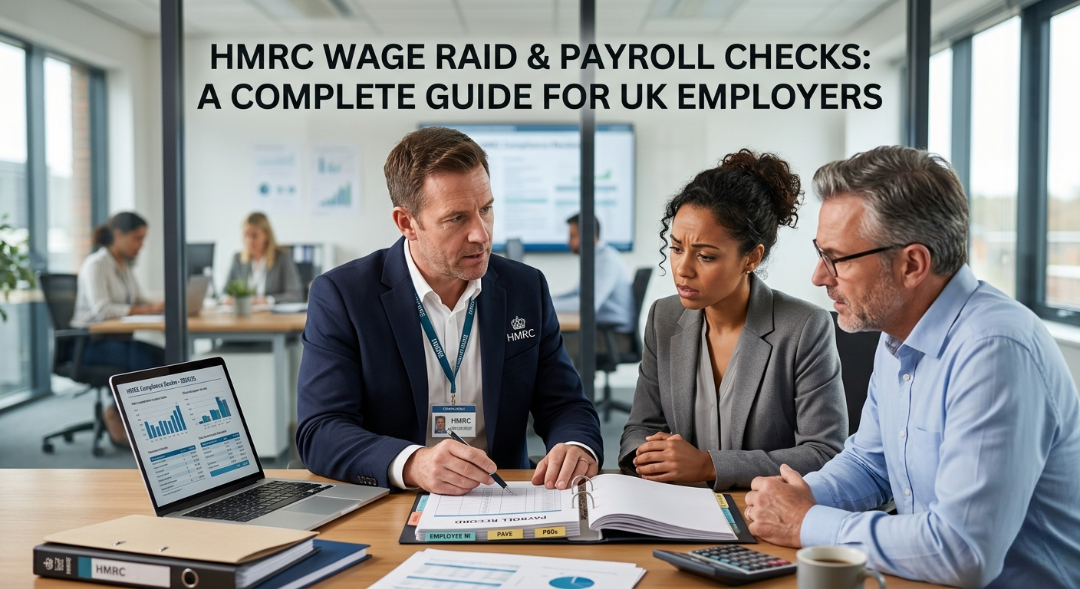

HMRC Wage Raid & Payroll Checks: A Complete Guide for UK Employers
Payroll compliance in the UK has become more closely monitored than ever, and many employers now worry about sudden investigations or so-called “HMRC wage raids.” While the phrase sounds dramatic, it typically refers to unannounced or formal compliance checks carried out by the UK tax authority, HM Revenue & Customs.
These payroll checks are not random acts of disruption. Instead, they are part of a structured enforcement strategy designed to ensure businesses are correctly reporting wages, paying the right taxes, and following employment law obligations.
In this guide, we break down exactly what HMRC wage raid payroll checks involve, why they happen, how they unfold, and most importantly how businesses can stay fully compliant and avoid penalties.
Whether you run a small business, manage HR, or handle payroll internally, understanding these processes can protect your company from financial and legal risk.
What Is an HMRC Wage Raid?
The term “wage raid” is not an official HMRC term. It is commonly used in media and business circles to describe:
- Surprise inspections of payroll records
- Targeted compliance audits
- Investigations into suspected tax avoidance or payroll fraud
- On-site visits by HMRC compliance officers
In reality, these are part of structured enforcement procedures conducted by HM Revenue & Customs to ensure employers are:
- Paying employees correctly
- Deducting the right Income Tax and National Insurance
- Reporting payroll data through RTI (Real Time Information)
- Following minimum wage laws
- Avoiding off-payroll or “cash-in-hand” arrangements
A wage raid may be announced or unannounced depending on the severity of suspicion or risk indicators.
Why HMRC Carries Out Payroll Checks
HMRC does not randomly target businesses. Instead, payroll checks are usually triggered by risk signals or inconsistencies.
Common reasons include:
1. Payroll inconsistencies
- Mismatched RTI submissions
- Sudden wage fluctuations
- Incorrect tax code usage
2. National Minimum Wage concerns
- Employees being underpaid
- Incorrect apprenticeship rates
- Excessive unpaid working hours
3. Irregular cash payments
- Large amounts of cash wages
- Lack of proper payroll records
4. Employee complaints
- Workers reporting underpayment
- Disputes over payslips or deductions
5. Data matching anomalies
HMRC cross-checks:
- Bank data
- VAT returns
- Company accounts
- Pension submissions
6. Industry risk profiling
Certain sectors face higher scrutiny:
- Hospitality
- Construction
- Care services
- Retail
- Gig economy businesses
What Happens During an HMRC Wage Raid?
When HMRC initiates a payroll investigation or visit, it usually follows a structured process.
1. Arrival of compliance officers
Officers may arrive unannounced at business premises. They will present identification and explain the purpose of the visit.
2. Request for records
HMRC may request access to:
- Payroll software
- Employee contracts
- Payslips
- RTI submissions
- Timesheets and attendance records
- Bank payment records
3. Employee interviews
In some cases, officers may speak directly to staff to confirm:
- Hours worked
- Payment accuracy
- Working conditions
4. Data analysis
HMRC compares internal records with submitted tax data to identify discrepancies.
5. Follow-up investigation
If issues are found, HMRC may extend the investigation into a full compliance audit.
Types of HMRC Payroll Checks
Not all investigations are the same. HMRC uses different levels of scrutiny depending on risk.
1. Routine compliance check
A standard review of payroll records without serious suspicion.
2. Targeted investigation
Triggered by specific concerns such as underpayment or tax avoidance.
3. Full employer compliance review
A detailed audit covering multiple tax years.
4. Criminal investigation (rare)
Reserved for serious fraud or deliberate tax evasion cases.
What HMRC Looks for in Payroll Audits
During wage raids and payroll inspections, HMRC focuses on key compliance areas.
Payroll accuracy
- Correct gross-to-net calculations
- Proper tax deductions
- Accurate overtime payments
Real Time Information (RTI) compliance
Employers must submit payroll data on or before payday.
National Minimum Wage compliance
Checks ensure employees are not underpaid, including:
- Training time
- Travel time (in some cases)
- On-call hours
Employment status classification
HMRC assesses whether workers are correctly classified:
- Employee
- Worker
- Self-employed contractor
Misclassification is a major risk area.
Benefits and expenses reporting
Company benefits must be properly reported and taxed.
Warning Signs That May Trigger HMRC Attention
Businesses often unknowingly attract HMRC scrutiny. Key red flags include:
- Frequent payroll corrections
- Late RTI submissions
- Large amounts of manual payroll adjustments
- High use of subcontractors
- Significant cash wage payments
- Discrepancies between accounts and payroll data
Even small inconsistencies can trigger a deeper review.
Penalties for Payroll Non-Compliance
If HMRC finds errors during a wage raid or payroll audit, penalties can be significant.
Financial penalties may include:
- Backdated tax payments
- Interest on unpaid tax
- Fines for late reporting
- Penalties for incorrect RTI submissions
Serious cases may involve:
- Penalties up to 100% of unpaid tax
- Public naming of non-compliant employers
- Criminal prosecution (in severe fraud cases)
How Long Do HMRC Payroll Investigations Last?
The duration depends on complexity:
- Minor checks: a few weeks
- Standard audits: 3–6 months
- Complex investigations: 1 year or more
Delays often occur when businesses fail to provide complete records quickly.
How to Prepare for HMRC Payroll Checks
Preparation is the most effective way to reduce risk.
1. Maintain accurate payroll records
Ensure all employee data is:
- Up to date
- Consistent
- Properly archived
2. Use compliant payroll software
Modern systems reduce human error and improve RTI compliance.
3. Conduct internal audits
Regularly review:
- Payroll calculations
- Tax deductions
- Employee classifications
4. Train payroll staff
Ensure staff understand:
- HMRC rules
- Minimum wage laws
- Reporting deadlines
5. Keep documentation organized
HMRC may request:
- Contracts
- Timesheets
- Payment records
How to Respond During an HMRC Wage Raid
If HMRC visits your premises:
Do:
- Stay calm and cooperative
- Provide requested documents promptly
- Assign a responsible manager or payroll officer
- Keep communication professional
Don’t:
- Hide or alter records
- Delay responses unnecessarily
- Provide incomplete information
Cooperation can significantly reduce penalties.
Common Mistakes Employers Make
Many payroll issues arise from avoidable mistakes:
- Incorrect employee classification
- Poor record-keeping
- Manual payroll errors
- Ignoring minimum wage updates
- Late RTI submissions
- Misunderstanding overtime rules
Even honest mistakes can result in penalties if not corrected quickly.
Expert Insight: Why HMRC Focuses Heavily on Payroll
Payroll is one of the most sensitive areas of taxation because it directly affects employee income and government revenue.
From an enforcement perspective, payroll checks are effective because:
- Data is digitally reported in real time
- Employers are responsible for deductions
- Errors are easy to detect through cross-matching
- High compliance risk industries are identifiable
This makes payroll a priority area for HM Revenue & Customs enforcement strategy.
How to Avoid HMRC Payroll Problems Long-Term
Sustainable compliance requires ongoing effort:
- Implement monthly payroll reconciliations
- Stay updated with UK tax law changes
- Use automated payroll systems
- Schedule annual external audits
- Maintain clear HR documentation
Consistency is key to avoiding unexpected investigations.
Conclusion
HMRC wage raid payroll checks are a serious but manageable aspect of running a business in the UK. While the term “raid” may sound alarming, these inspections are ultimately designed to ensure fairness, transparency, and correct tax reporting.
By understanding how HM Revenue & Customs operates, maintaining accurate payroll systems, and proactively addressing compliance risks, businesses can avoid penalties and operate with confidence.
The key takeaway is simple: good payroll hygiene is not optional it is essential for long-term business stability and legal protection.
FAQ: HMRC Wage Raid Payroll Checks
1. What is an HMRC wage raid?
It refers to an unannounced or targeted payroll inspection by HMRC to check tax and wage compliance.
2. Can HMRC come to my business without warning?
Yes. In many cases, compliance officers may arrive without prior notice.
3. How long do payroll checks take?
Anywhere from a few weeks to over a year, depending on complexity.
4. What triggers HMRC payroll investigations?
Common triggers include payroll errors, late RTI submissions, and minimum wage concerns.
5. What happens if HMRC finds mistakes?
You may need to pay backdated tax, interest, and penalties.
6. Can small businesses be targeted?
Yes. HMRC investigates businesses of all sizes, especially in high-risk sectors.
7. How can I prepare for HMRC checks?
Maintain accurate records, use payroll software, and conduct internal audits regularly.