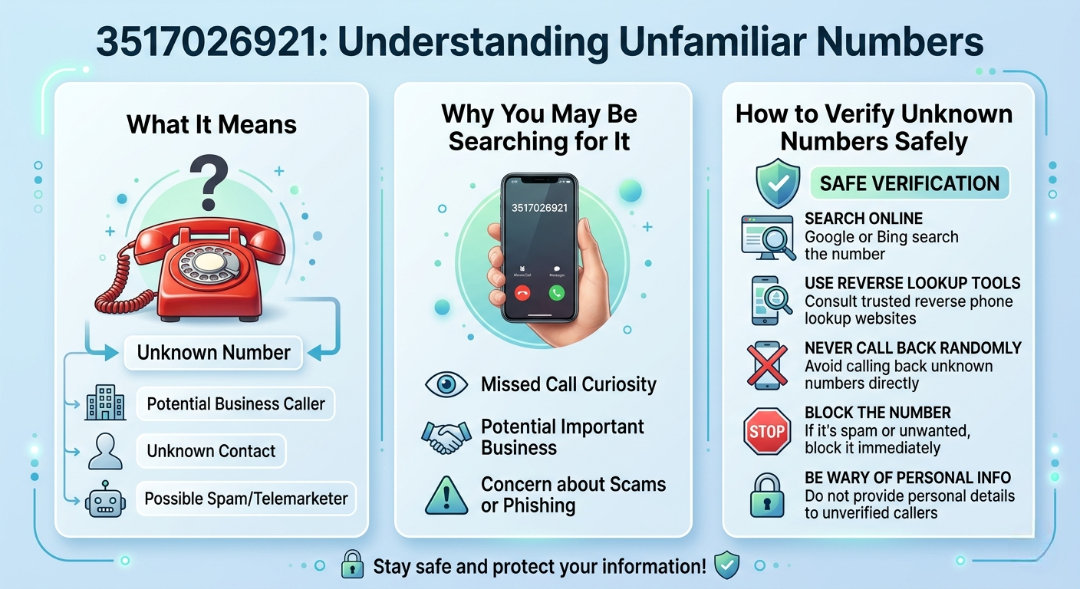

3517026921: What It Means, Why You May Be Searching for It, and How to Verify Unknown Numbers Safely
If you’ve searched for 3517026921, you’re probably looking for answers after seeing the number on your phone, in a missed call, text message, online record, or another document. Unknown numbers naturally raise questions, especially as spam calls and fraudulent communications continue to increase worldwide. While a number by itself rarely reveals its true owner without verified data, there are several reliable ways to investigate it safely. This guide explains what 3517026921 could represent, how to determine whether it’s legitimate, the warning signs of scam activity, and the best practices for protecting your personal information throughout the verification process.
What Is 3517026921?
The number 3517026921 appears to be a standard 10-digit numeric sequence. Depending on where you encountered it, it could be associated with several different situations, including:
- A missed phone call
- An incoming SMS message
- A business contact number
- An automated notification
- A customer service callback
- A delivery confirmation
- A financial institution alert
- A verification call
- A telemarketing campaign
- A robocall
Without access to official telecommunications records, it’s impossible to accurately identify the owner of the number based solely on the digits.
This is an important distinction because many websites make unsupported claims about unknown phone numbers. Responsible identification always relies on verified information rather than speculation.
Why Are So Many People Searching for 3517026921?
Searches for unknown phone numbers have become increasingly common.
Most people look up a number after experiencing one of these situations:
- The phone rang only once.
- The caller hung up immediately.
- Multiple missed calls appeared.
- A suspicious text message arrived.
- The caller requested personal information.
- The number repeatedly contacted them.
- They were expecting an important call.
- They wanted to know whether returning the call was safe.
In many cases, people simply want reassurance before interacting with an unfamiliar caller.
Can 3517026921 Be Identified Online?
Sometimes.
Whether a number can be identified depends on several factors:
Public Business Listings
If the number belongs to a registered business, it may appear in:
- Company websites
- Customer support pages
- Business directories
- Local listings
Businesses often publish their official contact numbers for customer convenience.
Community Reports
Users sometimes report numbers that repeatedly contact large numbers of people.
Reports may describe:
- Telemarketing
- Survey calls
- Debt collection
- Appointment reminders
- Delivery notifications
- Scam attempts
However, community reports should never be treated as definitive proof because anyone can submit information.
Private Numbers
Many legitimate numbers will have no public information at all.
This does not automatically indicate fraudulent activity.
Is 3517026921 a Scam Number?
There is no reliable evidence that 3517026921 is automatically a scam simply because it appears unfamiliar.
Instead of focusing solely on the number itself, evaluate the caller’s behavior.
Common scam warning signs include:
- Asking for banking information
- Requesting OTP or verification codes
- Demanding immediate payment
- Creating unnecessary urgency
- Threatening legal action
- Pretending to represent government agencies
- Offering unrealistic prizes
- Requesting remote access to your device
A legitimate organization rarely pressures customers into making immediate financial decisions over an unsolicited phone call.
How to Verify an Unknown Number Safely
Instead of calling back immediately, follow a structured verification process.
Step 1: Search the Number
Begin by searching the exact number online.
You may find:
- Business listings
- Public reviews
- Consumer complaints
- Official contact pages
Always compare information from multiple trustworthy sources.
Step 2: Check Recent Messages
Think about whether you recently:
- Ordered a package
- Scheduled a doctor’s appointment
- Contacted customer support
- Applied for a job
- Booked travel
- Requested technical assistance
Many legitimate callbacks come after actions you initiated.
Step 3: Listen to Voicemail
Legitimate callers usually leave:
- Their name
- Company
- Reason for calling
- Callback instructions
Scam callers frequently avoid leaving detailed messages.
Step 4: Contact the Organization Directly
If the caller claims to represent a company:
- Visit the company’s official website.
- Locate its published customer support number.
- Call using the official contact details.
Never rely solely on the number that contacted you.
Step 5: Avoid Sharing Sensitive Information
Never disclose:
- Passwords
- Banking PINs
- Debit card details
- Credit card CVV numbers
- Social Security or national identity numbers
- One-time passwords
- Authentication codes
Legitimate organizations typically do not request this information through unexpected phone calls.
Why Unknown Calls Have Increased
Several trends have contributed to the rise in unknown numbers.
Automated Dialing Systems
Businesses increasingly use automated systems for:
- Appointment reminders
- Delivery updates
- Customer feedback surveys
- Payment reminders
These calls may come from unfamiliar numbers.
Caller ID Spoofing
Modern technology allows scammers to disguise caller IDs.
This practice is called caller ID spoofing.
A displayed number does not always represent the caller’s true identity.
International Calling
Global communication means calls may originate from different regions due to:
- Customer support centers
- International businesses
- Remote work
- Travel
An unfamiliar number is not necessarily suspicious.
What Should You Do If You Missed a Call from 3517026921?
If you missed a call from 3517026921, consider the following checklist.
Wait Briefly
Legitimate callers often call again if the matter is important.
Check for Voicemail
A genuine caller is more likely to leave a message explaining the purpose of the call.
Search Online
Look for public information before returning the call.
Think About Recent Activity
Ask yourself whether you were expecting communication from:
- Banks
- Couriers
- Employers
- Healthcare providers
- Government departments
Return the Call Only If Appropriate
If the number appears legitimate after verification, returning the call may be reasonable.
How to Recognize Legitimate Business Calls
Professional organizations usually follow consistent communication practices.
Typical characteristics include:
- Identifying themselves immediately
- Explaining the reason for calling
- Respecting your privacy
- Allowing you to verify their identity
- Not demanding immediate payment
- Offering official contact methods
Transparency is one of the strongest indicators of legitimacy.
Red Flags That Should Never Be Ignored
Regardless of which number contacts you, remain cautious if the caller:
- Demands cryptocurrency payments
- Requests gift cards
- Asks for remote computer access
- Claims you’ve won money unexpectedly
- Pressures you into immediate decisions
- Refuses verification
- Threatens arrest or legal consequences
- Requests confidential authentication codes
Ending the call is often the safest response when multiple warning signs appear.
Should You Block 3517026921?
Blocking a number depends on your experience.
Consider blocking it if:
- The caller repeatedly harasses you.
- Multiple unwanted calls occur.
- The caller behaves aggressively.
- Fraudulent activity is suspected.
- The calls continue after you ask them to stop.
However, avoid blocking immediately if you’re expecting important communications, since some businesses may use temporary outbound numbers.
How to Protect Yourself from Phone Scams
Strong security habits reduce the risk of becoming a victim.
Enable Spam Protection
Many smartphones include built-in spam detection features.
Keep them activated whenever possible.
Keep Software Updated
Security updates improve protection against fraud and malicious attacks.
Install updates promptly.
Verify Before Trusting
Never assume a caller is legitimate simply because they:
- Know your name
- Mention your address
- Reference a recent purchase
Some personal information may already be publicly available or obtained through unrelated data breaches.
Use Multi-Factor Authentication
Whenever possible, enable additional account security.
Even if someone learns your password, they may still be unable to access your account.
Report Suspicious Calls
If you believe you’ve encountered fraudulent activity:
- Report the incident to your mobile provider.
- Notify relevant consumer protection agencies.
- Inform your financial institution if banking information was discussed.
Reporting helps reduce scams affecting others.
Common Reasons Legitimate Organizations Call
Not every unknown call is suspicious.
Some perfectly legitimate reasons include:
- Package delivery confirmation
- Medical appointment reminders
- School notifications
- Utility service updates
- Insurance follow-ups
- Banking fraud alerts
- Employment interviews
- Customer support callbacks
- Service appointments
- Account verification
Context matters far more than the number itself.
Conclusion
Searching for 3517026921 is a sensible step if you’ve received an unexpected call or message and want to make an informed decision before responding. While there is no verified public information that conclusively identifies this number, unfamiliar numbers are not automatically malicious. The safest approach is to assess the caller’s behavior, look for independent verification, avoid sharing sensitive information, and contact organizations through their official channels whenever verification is needed.
As phone scams continue to evolve, informed users are the strongest defense. By following the practical verification methods outlined in this guide, you can confidently handle unknown calls, protect your personal information, and distinguish legitimate communications from potential fraud without relying on speculation or unverified claims.
Frequently Asked Questions
What is 3517026921?
It is a phone number that people may search after receiving a call, text message, or missed call. Without verified records, its owner cannot be confirmed solely from the number.
Is 3517026921 dangerous?
There is no evidence that the number itself is inherently dangerous. Instead, evaluate the behavior of the caller and verify any claims independently.
Should I call 3517026921 back?
Only after determining that the call appears legitimate. Check for voicemail, search available public information, and verify any organization through its official contact details.
Can a phone number reveal personal information?
Generally, a phone number alone does not provide reliable ownership details to the public. Claims made by unofficial websites should be viewed carefully.
What if the caller asked for my banking information?
Do not provide sensitive financial information during unsolicited calls. Contact your bank using its official customer service number if you are uncertain.
Why do scammers use unfamiliar numbers?
Scammers frequently rotate phone numbers or use caller ID spoofing to increase the likelihood that recipients answer the call.
Can legitimate companies call from unknown numbers?
Yes. Many organizations use third-party calling systems, automated dialers, or regional contact centers, causing unfamiliar numbers to appear on caller ID.
How can I reduce unwanted calls?
You can:
- Enable spam filtering.
- Block persistent nuisance numbers.
- Register for available telemarketing preference services where applicable.
- Avoid sharing your phone number unnecessarily.
- Stay cautious when entering contests or online forms.