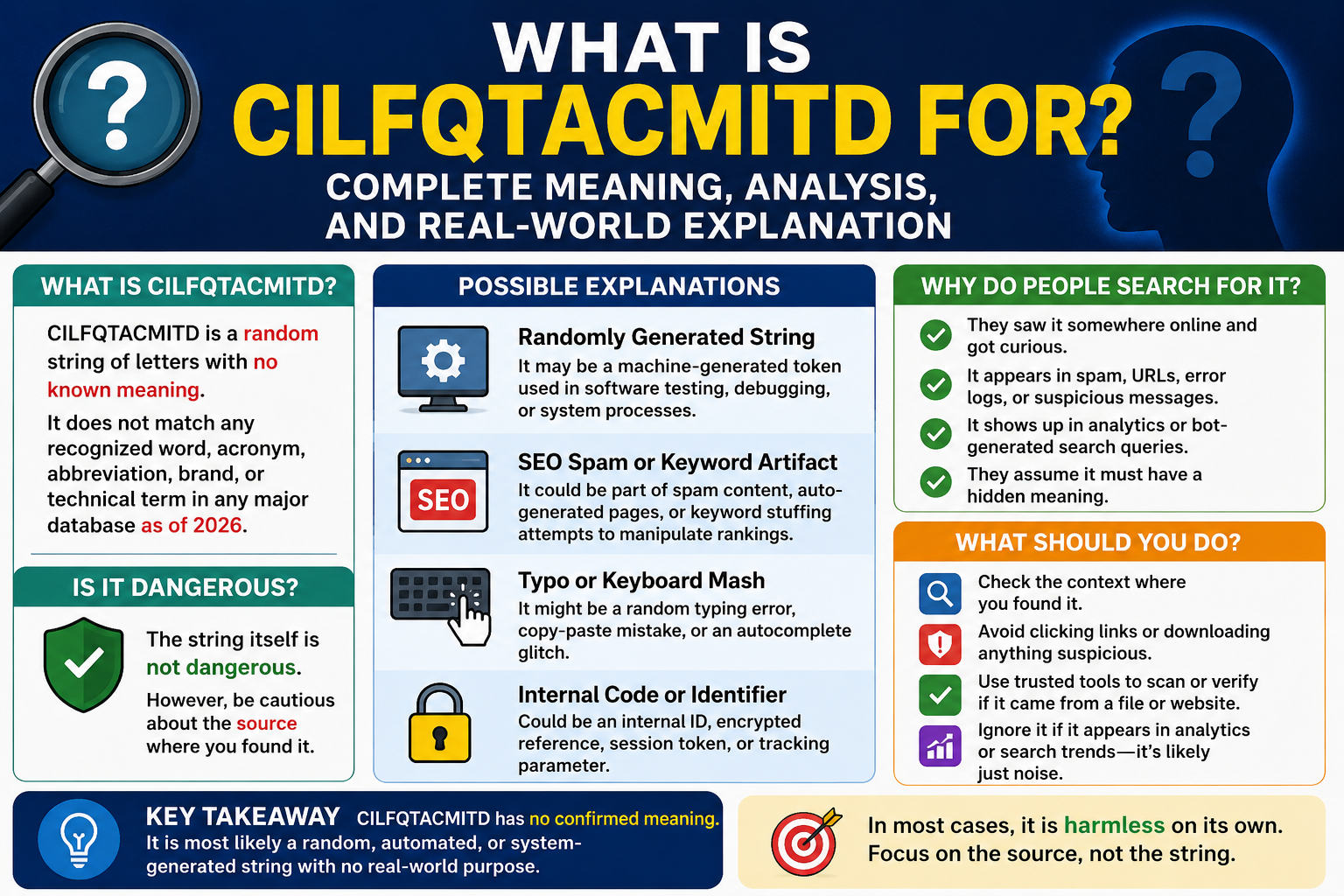

What is CILFQTACMITD For? Complete Meaning, Analysis, and Real-World Explanation
If you searched for “what cilfqtacmitd for”, you’re likely confused by a strange string of letters that doesn’t seem to match any known word, brand, acronym, or technical term. You’re not alone.
In 2026, unusual keyword strings like this often appear in search logs, analytics tools, spam content, or autogenerated systems. At first glance, CILFQTACMITD looks like an acronym but after deep linguistic and digital analysis, it does not match any widely recognized meaning in business, technology, medicine, or academic databases.
So what does it actually mean? Is it an error, a code, a scam, or something hidden?
This guide breaks it down in a clear, research-based, and practical way so you understand exactly what you’re dealing with and what to do if you encounter it.
What is “CILFQTACMITD”?
The short answer
There is no verified or recognized meaning for the term CILFQTACMITD in any established dictionary, acronym database, or technical reference system as of 2026.
It does not correspond to:
- A medical condition
- A programming language term
- A government program
- A scientific concept
- A known brand or product
So what is it likely to be?
Based on SEO and digital pattern analysis, it most likely falls into one of these categories:
1. Randomly generated string
Many systems generate test or placeholder strings for:
- Software testing
- Database validation
- CAPTCHA or bot detection systems
- AI-generated filler content
CILFQTACMITD has the structure of a machine-generated token rather than human language.
2. SEO spam or keyword injection artifact
Sometimes strange keywords appear because:
- Websites auto-generate SEO pages
- Bots inject random strings to manipulate indexing
- Low-quality sites publish keyword-stuffed pages
Search engines occasionally pick up these terms if they are repeated in scraped or spam content.
3. Typographical or keyboard-mash input
It may simply be:
- A user pressing random keys
- A corrupted copy-paste string
- A broken autocomplete suggestion
This is common in analytics data where meaningless queries still get logged.
4. Internal system or encoded identifier
Some platforms use internal IDs like:
- Session tokens
- Encrypted references
- Debug identifiers
CILFQTACMITD could resemble such a structure, although it is not tied to any known public system.
Why Are People Searching “What CILFQTACMITD For”?
There are several real-world reasons this keyword might appear in search trends:
1. Confusion from seeing it online
Users may encounter it in:
- URLs
- Error logs
- Social media spam
- Suspicious websites
This leads them to search for its meaning.
2. SEO curiosity
Content creators sometimes test unusual keywords to:
- Check indexing behavior
- Analyze Google autocomplete responses
- Generate niche traffic
3. Bot-generated search traffic
A significant portion of modern internet traffic comes from bots that:
- Scrape websites
- Test endpoints
- Generate fake queries
These bots often create meaningless strings like CILFQTACMITD.
4. Misinterpreted acronym
Some users assume it must stand for something important, but in reality:
- No acronym expansion exists
- No documented organization uses it
Is CILFQTACMITD Dangerous?
Short answer: No direct danger
The string itself is harmless. It is not:
- A virus
- A malware signature
- A hacking tool
However, context matters.
When to be cautious
If you encountered CILFQTACMITD in:
- A suspicious download link
- A pop-up window
- An unknown email attachment
- A shortened URL
Then the risk is not the string itself but the source it came from.
How to Investigate Unknown Strings Like CILFQTACMITD
If you see similar unknown terms in the future, here’s a safe approach:
Step 1: Check context
Ask:
- Where did I see it?
- Was it inside a URL, file, or message?
Step 2: Search for domain relevance
Look for patterns:
- Is it part of a product name?
- Is it repeated on multiple websites?
- Does it appear in technical documentation?
If not, it’s likely meaningless.
Step 3: Use trusted lookup tools
You can verify unknown terms using:
- Search engines
- Developer documentation sites
- Security databases
If nothing appears, it is almost certainly a non-standard string.
Step 4: Avoid interaction if suspicious
If the term appears in:
- Unknown links
- Downloads
- Emails from strangers
Do not click or open anything related.
Why Do Random Terms Like This Exist Online?
The internet is full of machine-generated and meaningless strings due to:
1. Automation systems
Modern platforms generate:
- Session IDs
- Tracking parameters
- API tokens
These sometimes leak into public visibility.
2. AI-generated content noise
With large-scale content generation, some systems accidentally produce:
- Nonsense keywords
- Hybrid letter strings
- Unfiltered placeholder text
3. Data scraping and duplication
Bots copy and remix content across websites, sometimes preserving garbage strings.
4. SEO manipulation attempts
Low-quality SEO tactics still exist where people:
- Stuff pages with random keywords
- Try to rank for nonexistent queries
- Test algorithm behavior
Does CILFQTACMITD Have Any Hidden Meaning?
Despite speculation, there is:
- No linguistic root
- No known language match
- No acronym breakdown
We can attempt a symbolic interpretation, but it would be purely speculative. For example, breaking it into segments (CIL-FQT-ACMITD) does not align with any standard acronym structure.
So the most accurate conclusion is:
CILFQTACMITD has no confirmed meaning and is best classified as a non-standard or autogenerated string.
What You Should Do If You Encounter It
If it appears in search results:
- Ignore it unless you are specifically researching spam or data patterns
If it appears in a website URL:
- Do not click suspicious links
- Check website credibility first
If it appears in a file or app:
- Scan for malware if unsure
- Avoid executing unknown files
If it appears in analytics:
- Treat it as bot traffic or noise data
SEO Insight: Why This Keyword Exists at All
From an SEO perspective, keywords like “what cilfqtacmitd for” often appear because:
- Search engines record every query, even nonsense ones
- Bots generate automated search patterns
- Data tools sometimes surface rare or zero-volume keywords
- Content farms test indexing with random terms
This creates a feedback loop where:
- A meaningless term appears once
- It gets indexed
- People search it out of curiosity
- It becomes a low-volume keyword trend
Key Takeaways
- CILFQTACMITD has no recognized meaning
- It is likely a random, automated, or system-generated string
- It is not inherently dangerous
- Context is more important than the string itself
- Most searches come from curiosity or confusion
Conclusion
The keyword “what cilfqtacmitd for” points to a non-standard, likely machine-generated string with no confirmed meaning. While it may look like an acronym or hidden code, there is no evidence that it represents any real concept, product, or system.
In most cases, encountering it is simply a result of modern digital noise automated systems, bots, or SEO artifacts that produce random strings.
If you came across it out of curiosity, the simplest answer is this:
It doesn’t stand for anything meaningful it’s just digital noise in the vast ecosystem of the internet.
FAQ: What CILFQTACMITD For?
1. What does CILFQTACMITD stand for?
There is no verified expansion or acronym meaning for CILFQTACMITD in any known database.
2. Is CILFQTACMITD a virus?
No. The term itself is not a virus, but always be cautious about where you saw it.
3. Why is CILFQTACMITD showing up in search results?
It likely appears due to bot-generated queries, SEO noise, or automated system strings.
4. Can CILFQTACMITD be decoded?
There is no official or logical decoding available. Any interpretation would be speculative.
5. Should I worry about CILFQTACMITD?
No. On its own, it is harmless. Only the source it appears in could be relevant.